
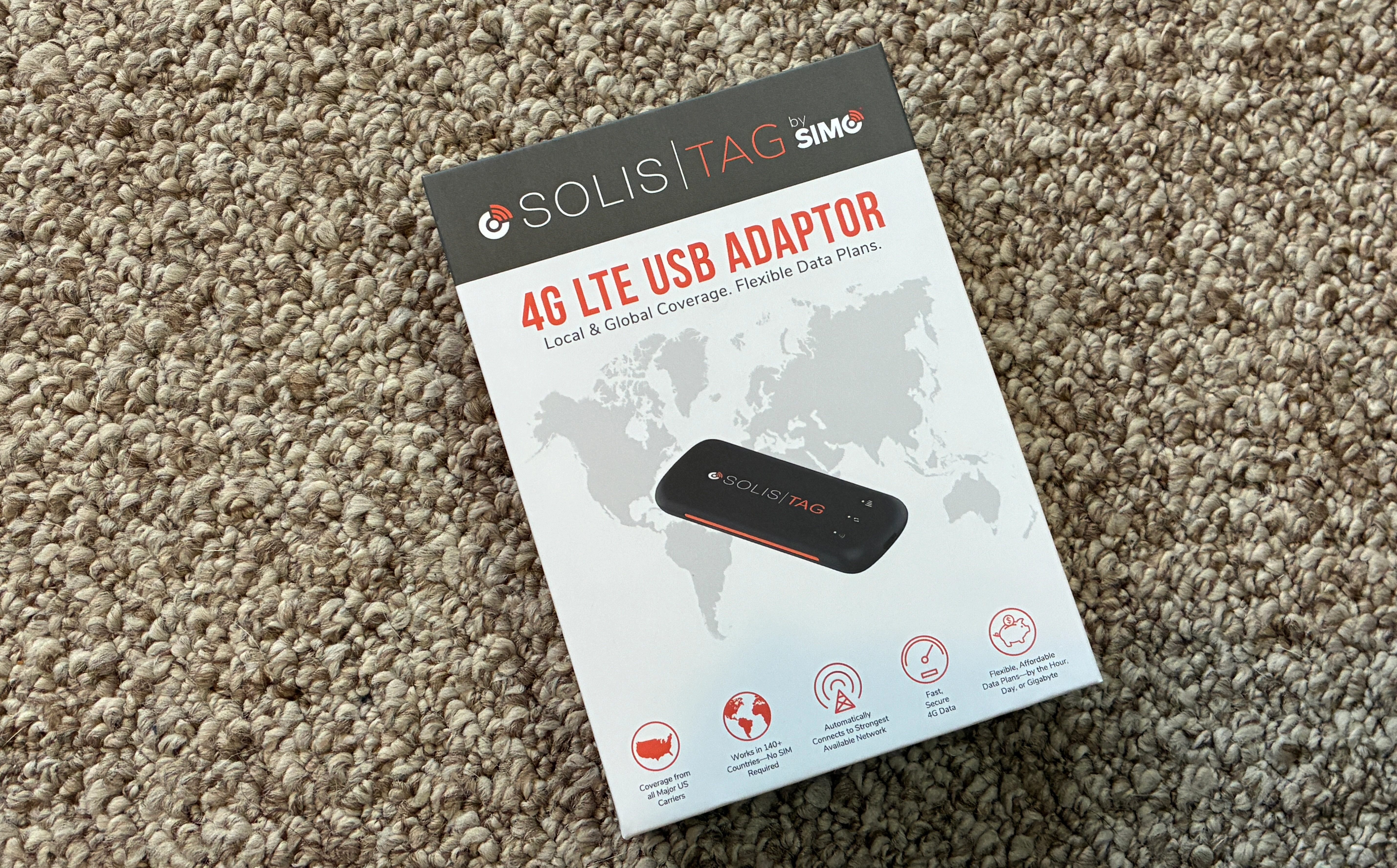


Many years ago now, I purchased a WiFi hotspot device then known as the Skyroam Solis. Then, a couple of years ago, I decided to upgrade to the Solis Pro 5G. Yet, when I learned that the company was releasing a new device called the Tag back in February, I decided to pick up yet another hotspot.
So, what is it about the Solis Tag that made it different from my other devices and got me to buy it? More importantly, do I still think it’s a good buy after using it for myself? Let’s take a look at some key things to know about the Solis Tag, including my experience so far.
Solis Tag Review: What You Need to Know
Pricing and Options
Here’s the thing: when I purchased the Solis Tag during its pre-sale period earlier this year, I paid around $55 for the device. That was marked down 20% from the advertised retail of $70. However, from what I can tell, that $70 price is not currently available.
Instead, if you go to the Solis site and select the Tag, you’ll find a price of $120 (as of July 28th, 2026) — which is apparently marked down from a retail of $200! However, for that price, you’ll also get a 30 GB Starter Pack of global data… that expires in 30 days.
There is another option, though — and one with its own sets of pros and cons. As of this writing, Solis is offering a 3GB Monthly Global Rollover Data 12-Month Subscription that includes a free Solis Tag device. Basically, you pre-pay for a year of service, which includes 3GB of global data per month and can roll over to the next month if it goes unused (for up to six months). This plan comes to $99… but there’s a $35 one-time device connection fee. So, the out-of-pocket total for the plan and device would be $134 before renewal. By the way, on that product page, it notes that the Solis is a $70 value, making the current pricing even more dubious.
Anyway, the good news is that Solis does offer free shipping with either of these options. Plus, if you want to save a few dollars, you can use my link and enter code MONEY30 and check out.
Included Data
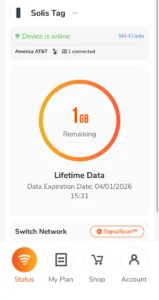
As with other recent Solis devices, the Tag includes a monthly allotment of included data. Specifically, you’ll get 1GB of global data each month for the life of your device. Note that this data won’t roll over from month to month and, if you do have any other data (such as the 30GB Starter Pack or 3GB rollover data), this 1GB will be used first.
The Tag “Twist”
So, with that out of the way, what exactly is it that makes the Solis Tag different from other Solis devices? Rather than acting as a powerbank like most Solis hotspots, the Tag can be powered by other devices. For example, you can simply plug it into your laptop (via USB C) in order to get it up and running. This is nice as it removed the necessity to keep your hotspot charged up.
Of course, if you don’t want to power it through another device, you could always plug it into a wall charger. But, just be aware that, once you unplug it, it will turn off as it does not hold a charge.
Size and Weight
With no screen, no large battery, and a less-than-rugged build, the Solis Tag is both small and light. I couldn’t find the exact stats on Solis’s site, but my scale has it weighing in at just 36 grams. Size-wise, I measured about 4 inches long by 1.5 inches wide and 0.5 inches thick. For context, you can see how it compares to the size of a credit card.
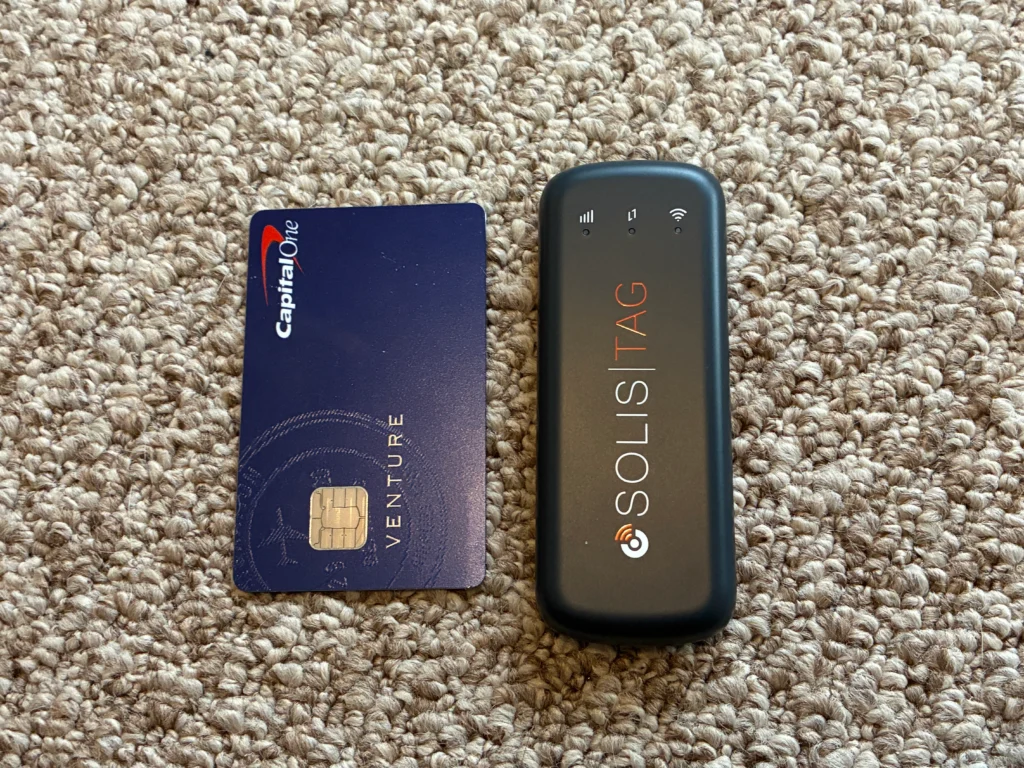
To me, this sizing makes it even better as a travel hotspot since it takes up very little room and adds hardly any weight to my bag.
Connection Speeds
Unfortunately, if you’re looking for the fastest connection, the Tag will not deliver for you. Rather than offering 5G connections, this model is limited to 4G LTE speeds. So, if you do want 5G support, you’ll want to look toward the Solis Pro or Solis Edge.
My Experience (So Far)
Speaking of connection speeds, that’s a good place to start my review. While staying at The Nash hotel in Nashville, I found the WiFi to be lacking — which then gave me the perfect opportunity to put the Tag to the test.
After running a speed test, the Solis Tag clocked in at 25.89 Mbps down and 34.85 Mbps up. That was a major improvement over the 5.71 Mbps download speeds I was getting on the hotel connection. Meanwhile, my Solis 5G managed 69.76 Mbps down and a similar 34.20 Mbps up.
Of course, unlike the Solis 5G, I didn’t have to worry about charging my Tag ahead of time — which I really do think is great. Plus, the device itself is so light that I have zero qualms about throwing it in my backpack regardless of whether or not I plan on using it. In fact, it’s basically lived in said backpack ever since I got it since there’s no good reason not to just bring it along on every trip I take.

- Powered by other devices with no need to charge
- Lightweight and small build
- 1 GB of global data per month included
- Only offers 4G LTE speeds (no 5G)
- Current pricing model puts the final cost higher than it should be
Final Thoughts on the Solis Tag Hotspot Device
When I bought my Solis Tag for $55, I thought it was a no-brainer. Rather than worrying about charging up my device before a trip, I could simply throw it in my bag as a backup — and know that I’d have at least 1GB of data if I needed it. Even at the $70 retail launch price, I think it would be a strong contender in Solis’s line-up.
Unfortunately, the way that Solis is currently selling the Tag severely hurts that value proposition. Rather than paying $70 for the device itself, you’re now forced to spend $120 for it to be bundled with 30GB of data that’s going to expire in just a month! If the 30GB were a reserve you could tap for, say, a year, it might be a different story. But, as it is, I can really only recommend this package to someone who knows they’ll be traveling very soon and has a use for those 30GBs.
Otherwise, I think the current 3GB rollover plan is the better deal, even if it costs more upfront. Of course, you’d also want to make sure you cancel after your prepaid year if you didn’t want to keep paying.
The other thing is that, if connection speed is top priority and you plan to use the device more often than as just a backup, then it probably makes sense to upgrade to a 5G device. Admittedly, the pricing on those is also a bit confusing at the moment, but I’d probably aim for the Solis Pro 5G.
With all of that said, I’m personally glad to have a Solis Tag and plan to take it along on many future trips. I just hope that Solis comes to its senses and brings back something close to the original pricing so that more customers can discover this clever backup hotspot device.
Per FTC guidelines, this website may be compensated by companies mentioned through advertising, affiliate programs or otherwise. (Note: advertising relationships do not have any influence on editorial content. Advertising compensation allows Money@30 to provide quality content for free. All editorial opinions are those of Kyle Burbank.)